Our Iroko Restoration Project Earned an "A" Rating from Sylvera — Here's What That Means
We're proud to share that the Iroko Restoration Project in Cameroon has received a Pre-Issuance Rating of ‘A’ from Sylvera, one of the world's leading independent carbon credit rating agencies. Here's what that means for the project and for interested funders and offtakers.
Why We Worked with Sylvera
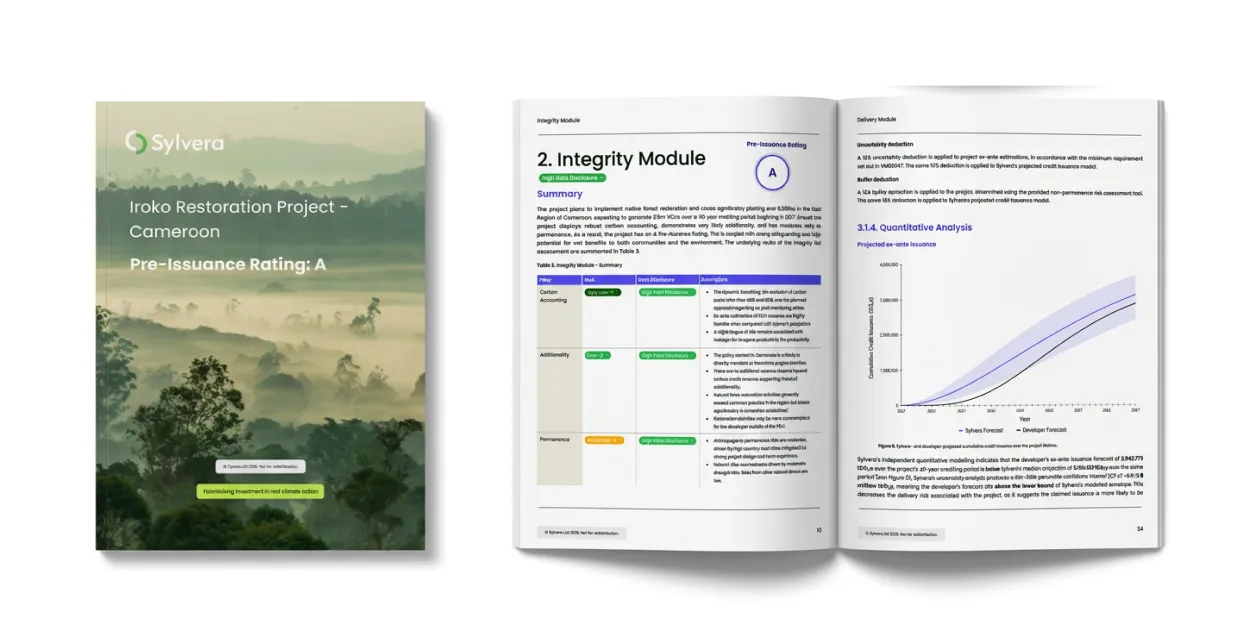
Carbon buyers are increasingly discerning, and rightly so. Independent ratings are becoming the new baseline expectation for high-integrity projects, and we wanted to meet that bar before we ever bring credits to market. We commissioned Sylvera to stress-test the Iroko Project's design, surface any gaps, and give buyers a credible third-party basis for confidence in the project. As the voluntary carbon market matures, validators like Sylvera are playing an increasingly important role in raising the bar for project quality, rewarding projects designed for accountability from the outset rather than retrofitted for compliance after the fact.
Native Forest Restoration at Scale
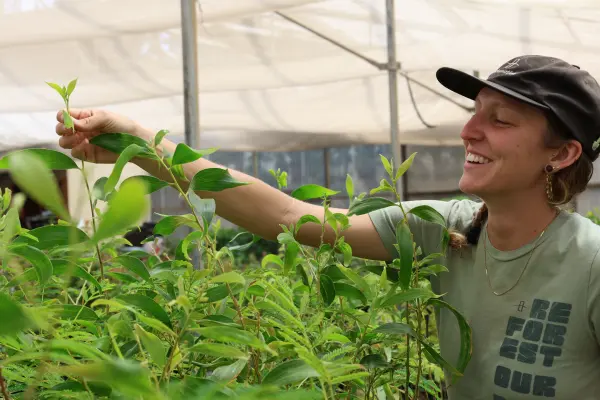
The Iroko Project plans to restore nearly 14,000 hectares (about 1.5x the size of Paris) of degraded communal land across two communal forests in the East Region of Cameroon. By planting more than 25 locally adapted native species, the project will rebuild biodiverse forests, mirroring the structure and resilience of the Congo Basin's native forests. A cocoa agroforestry component will also integrate selected native species to provide long-term shade needed for cocoa growth and support sustainable livelihoods. The project is expected to generate 4.9 million Verified Carbon Units (VCUs) with issuance starting as early as 2031.
The project, formally titled Increasing Carbon Stocks through the Reforestation of the Communal Forests of Ndélélé and Bétaré-Oya, is listed on Verra's registry under validation (VCS 5858) and is pursuing Climate, Community and Biodiversity (CCB) Standards certification at Biodiversity Gold Level, reflecting its potential to deliver exceptional biodiversity benefits through native forest restoration. The project embeds long-term stewardship by local communities by positioning them at the core of governance, restoration, and monitoring, while building capacities, securing sustainable livelihoods, and enabling inclusive decision-making. This approach is reinforced through alignment with ABACUS Label Guidance, ensuring enhanced integrity, transparency, and best-in-class practices.


The Rating and What It Actually Means
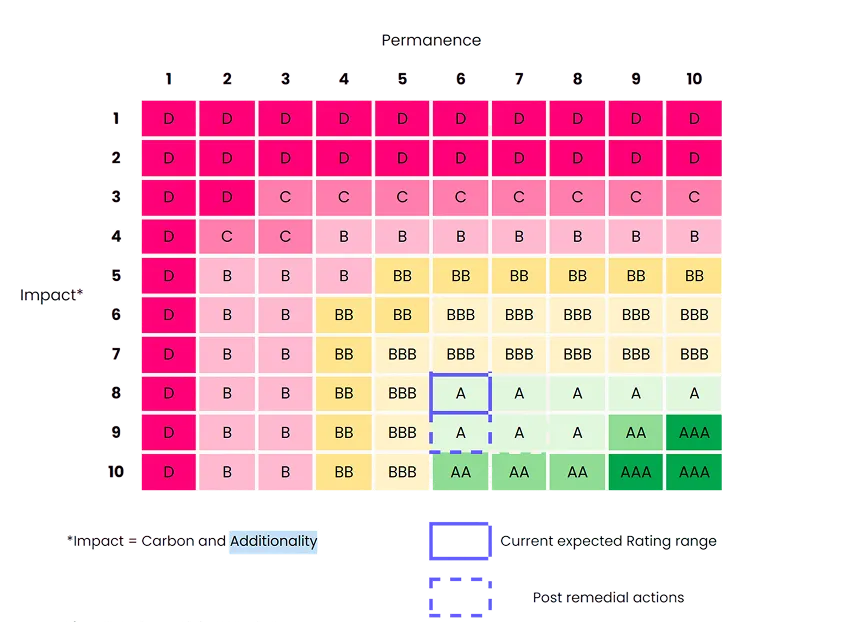
Sylvera rates projects on a scale from AAA to D. An A rating reflects low integrity risk and high confidence in the project's carbon accounting and design. The framework evaluates three core questions:
1. Will the project remove as much carbon as it is claiming?
Sylvera scored our carbon accounting at Very Low Risk (1 out of 5), their highest confidence level. Their independent modelling projected a median of approximately 3.2 million tCO2e over the 40-year crediting period. Our own forecast is approximately 2.9 million VCUs (1st instance only; this figure does not include the project’s full expansion). In Sylvera's words, "the developer's projections are conservative and more likely to be delivered." You have all heard the saying: underpromise, overdeliver.

2. Would this reforestation happen without carbon finance?
Sylvera assessed additionality as Low Risk (2 out of 5). The project is financially non-viable without carbon credit revenue, and Cameroon's policy environment does not mandate or incentivise native forest restoration at this scale. This reforestation only happens if carbon buyers fund it.
3. Will the forest actually last?
Sylvera assessed permanence as Moderate Risk (3 out of 5), reflecting anthropogenic risks mitigated by a strong project design and team experience. Natural risks, including fire, flood, storm, and pests were rated Low Risk, while drought risk was considered Moderate. The planting design reduces this risk, supported by a diverse range of 25+ native tree species and planting season to occur at the onset of the rainy season.


SDG Co-benefits Rated Very High Impact
The Iroko Project is more than a carbon story. It's a development story co-designed with local communities. Sylvera rated the project’s co-benefits as Very High Impact across five SDGs:

Project Team and Government Approval
Furthermore, Sylvera rated our project team at Very Low Risk (1 out of 5), acknowledging our experienced team as meaningful mitigating factors to permanence risk. On-the-ground implementation is led by the Centre Technique de la Forêt Communale (CTFC) and Iroko Analytics. CTFC, an NGO established in 2009 under the Government of Cameroon’s decentralised forest management initiative, brings over 15 years of experience, having supported more than 20,000 hectares of restoration and classified over 2 million hectares of forest nationwide. Iroko Analytics builds on over a decade of Congo Basin conservation work, contributing to the project’s design, financing, and MRV expertise to support implementation.
The project has also secured key government approvals. It is endorsed by Cameroon’s National REDD+ Committee, with a Letter of Approval and Endorsement issued by the Ministry of Environment (MINEPDED). It is also anchored in long-term agreements with the communal forests of Ndélélé and Bétaré-Oya.


Get Involved
The Iroko Restoration Project is now open to pre-issuance offtake and project funding discussions. To learn more about the project and access additional documentation, contact impact@terraformation.com.
For more information on Terraformation's native reforestation projects, visit terraformation.com.
Disclaimer:
A Sylvera Pre-Issuance Rating assesses the likelihood that the expected carbon impact of a project is a true representation of its real impact and is based on a combination of three corescoring pillars: Carbon Score, Additionality, and Permanence.Sylvera Ratings are statements of opinion on the carbon impact of a project at a certain point in time and not statements of fact, investment or financial advice, endorsements or recommendations to take or not take a particular action. Sylvera expressly disclaims allwarranties and liability. Refer to the Ratings Disclaimer at www.sylvera.com for more information