


.png)


Reflections from Davos: We Need 3 Big Hacks to 3X Reforestation by 2030

By Jad Daley and Yishan Wong
Behind the geopolitical noise at last week’s World Economic Forum in Davos, Switzerland, a quieter signal emerged. Leaders from government, business, and civil society are converging together on the reality that the health and resilience of our natural environment is pivotal for the health and resilience of businesses and our economy. That means we must increase cross-sectoral partnership and investment in nature-based solutions as if our people, planet, and businesses depend on it.
This convergence was underscored by the launch of the World Economic Forum’s Forest Future Alliance in Davos. This new collaboration will help empower companies and philanthropies with shared learning and tools, investable deployment opportunities, and enabling conditions needed to mobilize private sector resources into nature-based solutions partnerships with governments, Indigenous communities, and civil society actors.
It is no wonder that reforestation was at the forefront of these discussions in Davos, given the power of reforestation to simultaneously address climate change, accelerating biodiversity loss, and rising inequality. That includes the power of reforestation to increase resilience to the effects of climate change in addition to their carbon capture potential
That resilience dividend matters now more than ever as extreme weather disrupts shipping lanes, manufacturing hubs, agricultural regions, and energy systems around the globe. These impacts are no longer confined to climate reports or sustainability briefings; they are showing up in earnings calls, insurance pricing, procurement strategies, and the cost of capital. In 2025 alone, natural disasters drove $244 billion in economic losses, with weather extremes responsible for 92 percent of the total, according to Munich Re.
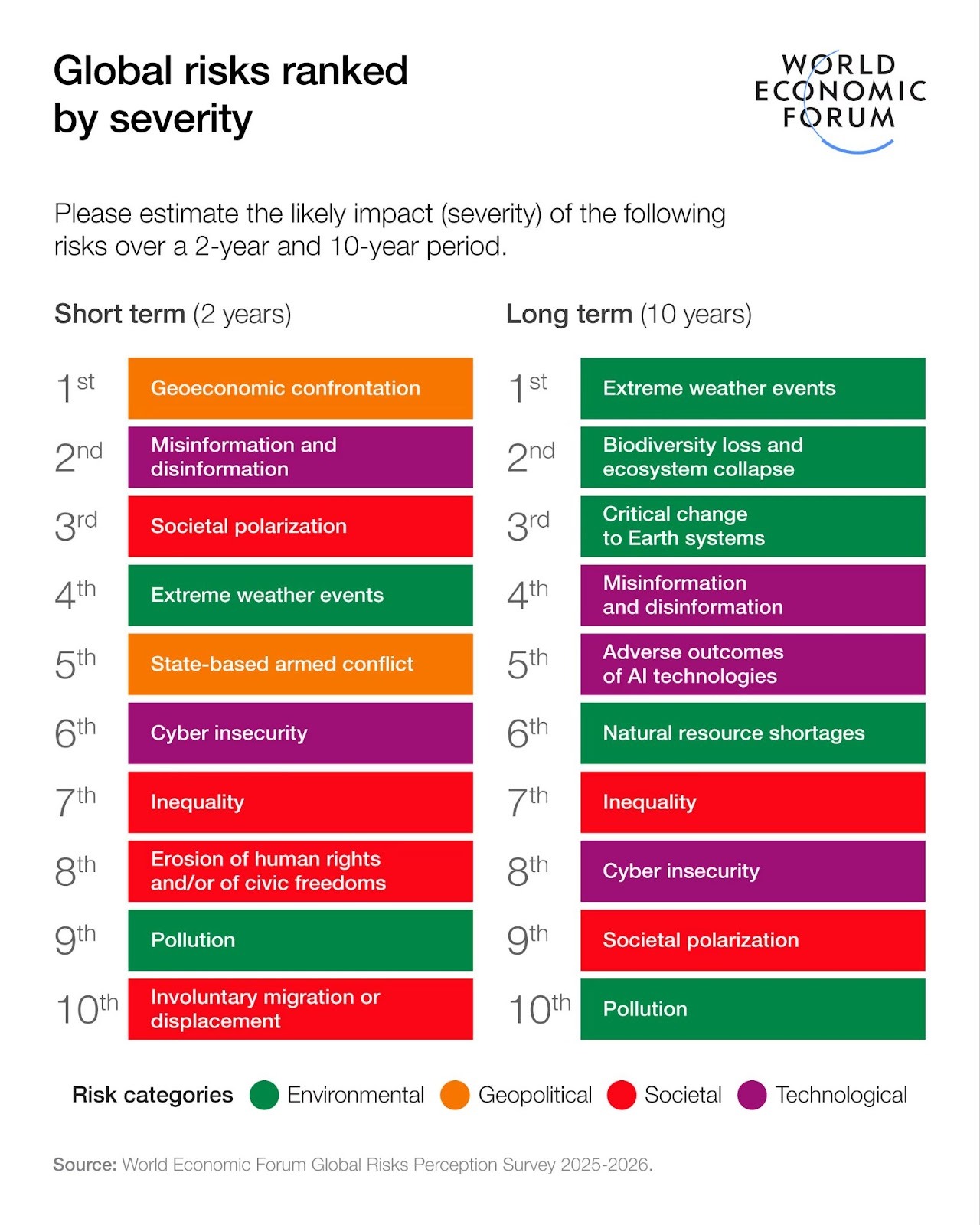
Business leaders already understand the underlying pattern: risk is compounding, and supply chains are becoming more fragile as a result. The World Economic Forum’s Global Risks analysis released in the run up to this year’s Annual Meeting placed climate and nature risks among the most severe threats over the coming decade, including “critical change to Earth systems,” biodiversity loss, and ecosystem collapse.
The implication was direct for the 850 CEOs and other business leaders in Davos: the world is entering a new era where climate resilience is a core business input, not a corporate side project. That means that investing in nature-based solutions that enhance resilience is not simply about corporate social responsibility or philanthropy–this investment is materially connected to a company’s long-term success.
So that brings us back to reforestation, from restoring coastal mangrove systems to tropical biodiversity hotspots and mountainous forests that collect and filter our water supplies. Reforestation offers one climate solution that can deliver risk reduction, economic development, and climate mitigation at the same time along with equal benefits for biodiversity and sustainable development.
There’s just one catch: this can’t be simply about planting more trees. Tapping the full power of reforestation globally and sustaining it over time demands locally-led reforestation of fully biodiverse forests accomplished at scale.
Whew, that is a lot in one phrase! Why all of that?
- Locally-led reforestation ensures that local communities will reap the economic benefits of restoring forests and have the incentive and capacity to sustain them into the future.
- Optimizing planting for biodiversity increases the resilience of forests to climate stress and their benefit for species recovery. (We know from experience–our organization is designing and implementing plantings that have in some cases 5x the species diversity found in comparable projects.)
- Scale is what takes reforestation solutions to the level where they really matter, from protecting people and the planet to protecting companies’ supply chains.
If this is the recipe for reforestation “done right”, we need to do a lot more of it, and quickly. According to new UNEP research, the planet must triple forest investment by 2030 to stabilize ecosystems, protect communities, and keep climate goals within reach. This need is especially acute in terms of private sector investment–a new study just released by One Earth Partners suggested that private sector investment in reforestation needs to increase closer to nine-fold to achieve our goals.
This is ambitious—but achievable, if we rebuild the systems that make restoration work.
That’s why we want to focus on systems level change in the reforestation movement that can unlock the needed private finance and other actions needed. From our complementary vantage points—one of us an engineer who sees climate as a physics problem, the other a practitioner who sees forests as a people-powered solution—we believe the path forward is clear.
To triple reforestation by 2030, we need three “hacks” that will unlock reforestation’s full global potential.

1. Hack the Reforestation Process
Most conversations about forests focus on funding. But the biggest inhibitors of reforestation success are process-related. Projects fail because we lack expertise, technical infrastructure, and repeatable execution systems to replant truly biodiverse and resilient forests.
Reforestation is a complex supply chain problem:
Seeds → nurseries → planting → maintenance → monitoring → long-term stewardship.
If any link is fragile, the entire effort collapses. This is only becoming more complex as our design for biodiverse reforestation becomes more and more rigorous in the tree species we use and how they are planted.
We will compress the timeline and maintain quality only when we treat reforestation like any other large-scale engineering challenge: standardizing systems, sharing tools, and building repeatable processes that can work across regions.
This means building and operating reforestation supply chains in modernized ways:
- Data-driven operations: Open-source tools, data standards, and platforms (like our organization’s Terraware software) can provide the operating system to help practitioners manage the reforestation supply chain for predictable inputs, high-quality production, and transparent reporting of outcomes.
- Seed and seedling production: The processes and the physical assets behind tree seed and seedling supplies, like seed collection programs and seed banks, are the unglamorous backbone of every successful reforestation program at scale, yet chronically lack the necessary investment and innovation. We need more investment in reforestation programs at this upstream production point.
In other words, if we truly want to go to scale, how effectively we spend each dollar and each hour that we put into the reforestation process is as important as how much we contribute.

2. Put People at the Center
No forest project succeeds without local leadership. Period.
Every thriving restored forest on Earth is guided by expert practitioners—often Indigenous or community-based—whose knowledge of the land spans generations. Their wisdom helps determine species selection, planting rhythms, and long-term care.
To triple reforestation by 2030, we need to elevate those practitioners by investing in capacity building at the local level that will give these lead actors access to the best possible information, tools, and finance. That’s how we build a global movement with a broad base, one that has the roots and resilience to succeed at scale.
To truly put people at the center and invest in them at scale, we must:
- Build just and equitable partnerships: Instead of land grabs or “plant-and-leave” forestry that is only about outcomes, we need to start with the human dimension by building long-term collaborations that weave capacity from global and national entities with local actors. These partnerships can address barriers like land tenure and concessionary rights to reforest, and can ensure we design and implement in harmony with local needs and perspectives.
- Pair ancestral ecological intelligence with artificial intelligence: We must engage with local leaders understanding that local knowledge is an equal input to braid together with our capacity to use tools like AI to model watersheds and inform the details of where and how we reforest.
- Deliver real financial uplift: Reforestation is unique in that it can’t be outsourced and is a labor-intensive activity with diverse employment opportunities along the reforestation supply chain. We can also enhance employment outcomes by integrating project elements that foster a circular economy, such as planting contained cacao plantations within larger rainforest reforestation projects. Lastly, we must also create generous revenue-sharing agreements that ensure all community members benefit by directing funds to community priorities.
Our organization knows this “people power” from our own experience working with diverse reforestation collaboratives around the world through our Seed to Forest Accelerator. This includes our partnership with local community-based organizations to reforest 5000 hectares of mangrove forest in Ghana’s Keta Lagoon, which started from a local effort reforesting just 50 hectares per year. With support from our Accelerator, that project has gone to scale while improving reforestation outcomes. This “reforestation done right” is creating more than 200 sustained local jobs in reforestation and layering in extra funding above the norm for community benefits, such as constructing a fish pond to assist with the local aquaculture economy as the mangrove forests and fish populations recover.
A people-centered approach isn’t only our ethical preference based on our values of equitable collaboration. It’s an evidence-based execution strategy built to produce results that last because community-first design reduces permanence risk, governance risk, and long-term delivery risk.
3. Hack Climate Finance
For more than two decades, the world has agreed that nature-based solutions deserve more funding. This year’s World Economic Forum in Davos was no exception, featuring plenty of panels on “scaling finance for nature.” Yet private capital still fails to flow at the scale required.
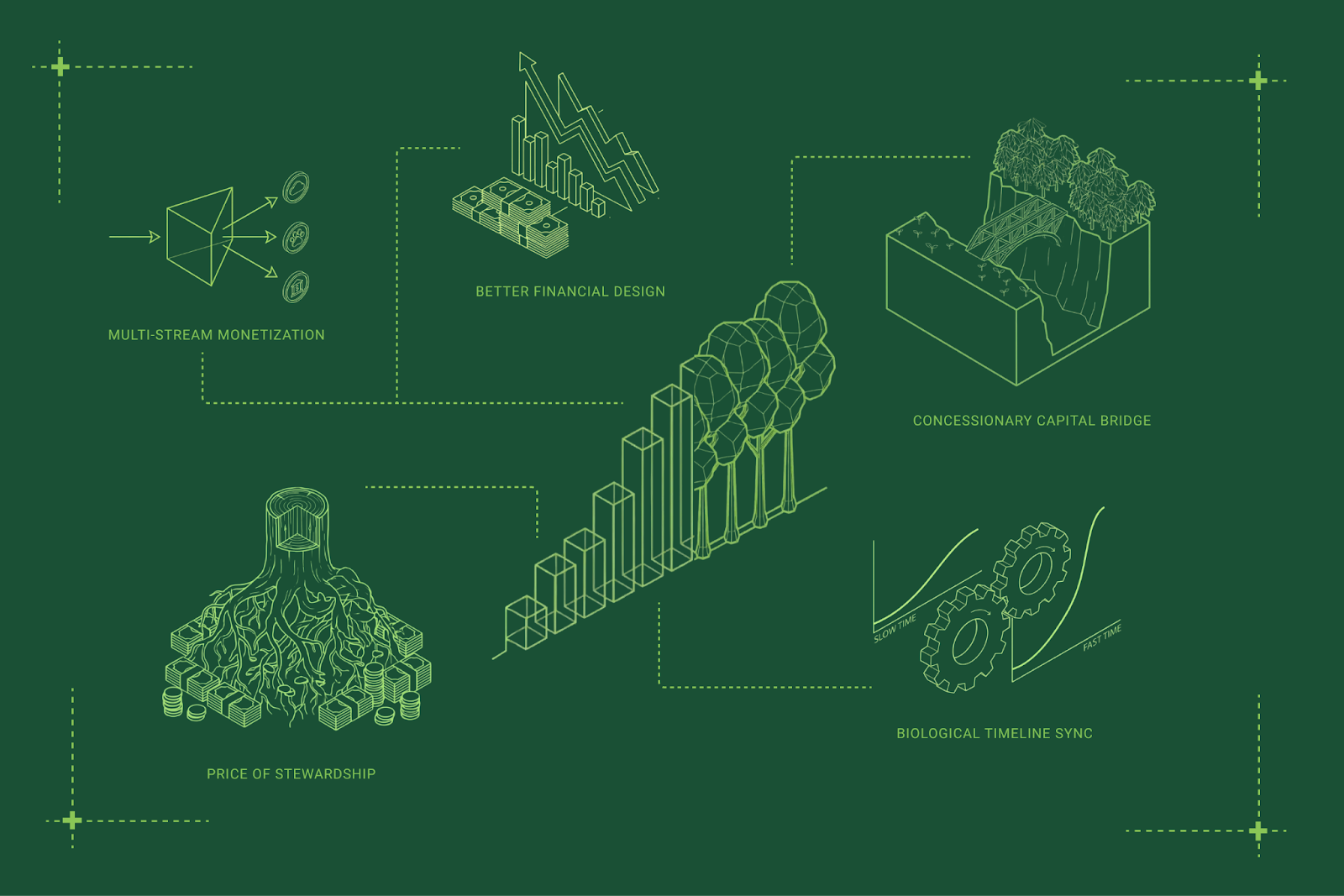
The problem is structural. Climate finance was built to fund the energy transition and other forms of traditional infrastructure, not living systems that require multi-year stewardship and carry inherent risks and uncertainties that are different from other kinds of infrastructure. Further, the immovable biological timelines to produce reforestation outcomes such as carbon sequestration don’t mesh easily with traditional approaches to monetization and investment.
Meanwhile, the cost of inaction is becoming easier to measure. One recent analysis highlights how extreme weather disruptions are already driving longer delivery times, higher costs, and lower output across global supply chains, with rising economic risks to global trade.
So instead of simply focusing on “more funding” we need to refine our focus on better financial design, built around the biological timelines, inherent risk factors, and flexibility necessary to both finance and implement nature-based solutions at a landscape-scale.
To drive reforestation to scale, we need instruments and finance opportunities that match how ecosystems recover and reforestation collaboratives operate:
- Concessionary capital for early implementation: Providing below market-rate capital for early year expenses will help reforestation projects through the “finance canyon” that occurs when project costs such as tree planting come years before outcomes can be monetized. Avoiding the need to incur expensive early year debt will make many more reforestation projects viable in carbon markets.
- More ways to pay for reforestation: Any steps we can take to expand beyond current finance opportunities in carbon markets will benefit reforestation progress, such as efforts through the Task Force on Nature Disclosure to make biodiversity benefits something that can be monetized. Also, there is real benefit to corporate social responsibility programs that fund reforestation outside of markets on the basis of rigorously measured benefits that are reported to the company supporting the project.
- Finance the whole process, including people: Private finance must be ready to value and pay for the process of stewardship along with seedling counts, tonnes of carbon, and other outputs. That means best-in-class financial structures and purchasing price points that integrate funding for the people centered approach we have outlined above, from generous community benefits provisions to sustained employment opportunities. This approach will cost more, and it is worth every penny for our values and our goals.
So as we come together in events such as the WEF Annual Meeting in Davos, Climate Weeks, and COP31, let’s challenge ourselves to be more specific about what changes are really needed to unlock the financing we need to scale reforestation done right.
A New Industry for a New Era
Are you fired up and ready to make these three big hacks across our movement so we can reforest the world? We know as a hybrid for-profit and non-profit organization that reforestation is emerging as a major global industry that will shape the next century, bringing joyful solutions to our greatest challenges and uplifting communities with a steady source of local employment that can’t be outsourced or displaced.
If we take the steps we have outlined above to triple reforestation by 2030, we will have the critical success factors for reforestation done right and taken to scale:
- A culture of innovation and high performance
- Shared protocols and digital infrastructure
- A trained and growing global workforce
- Predictable finance that matches the process
- Multi-sectoral partnerships anchored in just collaboration
- Deep community ownership and leadership
This is how sectors scale. The tech industry has already shown us how within timelines of years, not decades. Reforestation should be no different.
In tech, scale didn’t happen because everyone agreed on values. It happened because early infrastructure investment created compounding returns:
- standardized tools
- repeatable deployment models
- shared platforms
- faster learning cycles
- ecosystems of builders
By making our three big hacks, reforestation will gain the same: a global enabling layer that supercharges fragmented local excellence into global capacity. This is the kind of momentum that movements are born from.
The Business Case is Now the Climate Case
This year, conversations at Davos were weighted towards societal and economic risk: geopolitical instability, inflation, supply chain volatility, and the fragility of global growth. Yet, now more than ever, we must recognize that nature is increasingly the substrate under all of it.
A stable economy depends on stable water, stable food systems, and stable land.
Tripling reforestation by 2030 is possible with a hacker’s approach anchored in the ancient wisdom of people and community. The best possible braiding of old and new. This would dramatically increase the foundation of green infrastructure that underpins our society and economy, creating outcomes from the increased resilience we have discussed here to a measurable and dramatic increase in annual carbon removals, species recovery, and job creation.
However, this will only be possible if we build the systems, finance, and partnerships to make restoration investable, repeatable, and locally-led at a global scale. So let’s dig into the details together and hack the reforestation movement. Our planet and communities are ready and eagerly waiting.


