.png)


.png)
Ghana Forestry Commission and Terraformation Advance Forest Restoration Collaboration to Support Climate Resilience, Jobs, and Social Development


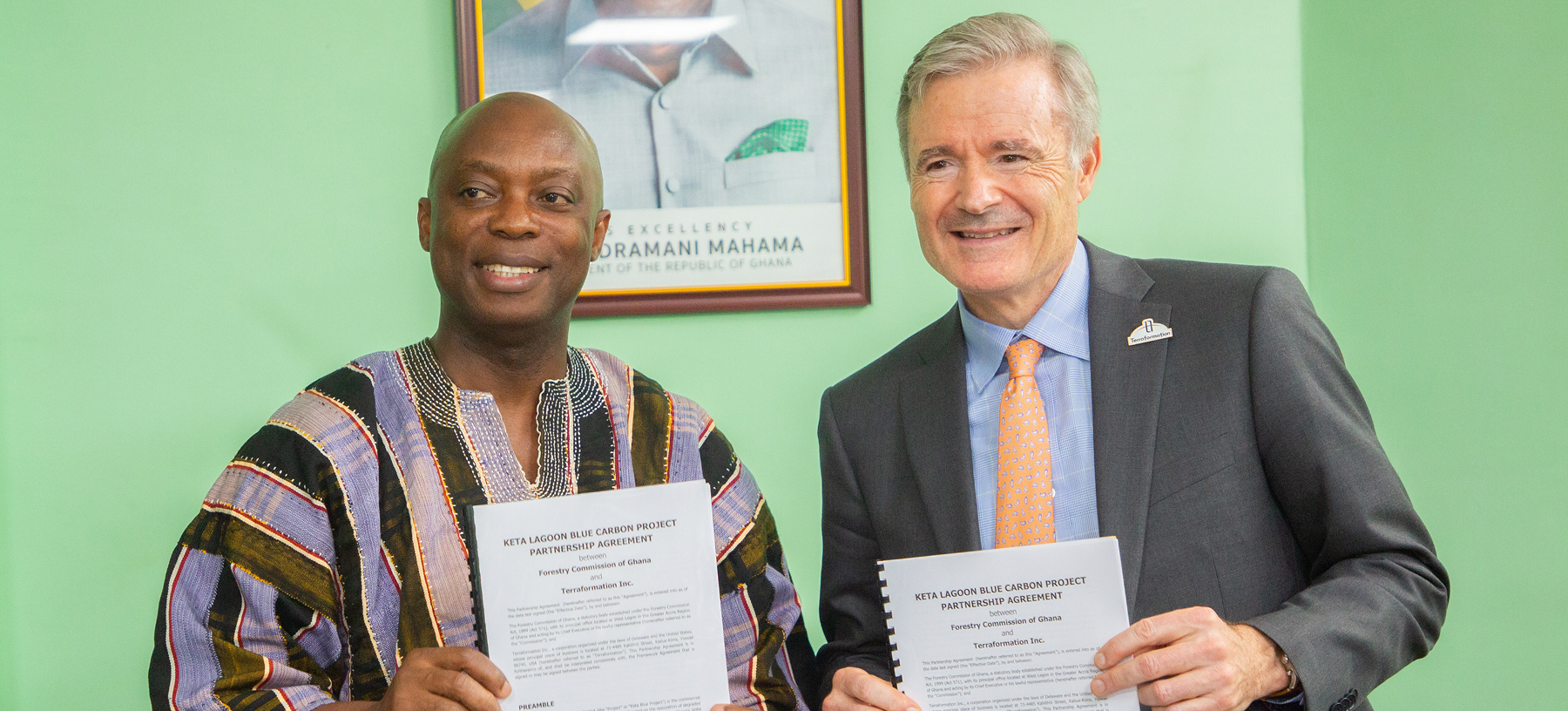
ACCRA, Ghana (March 26, 2026) — The Ghana Forestry Commission and Terraformation, a native, biodiverse reforestation company, today marked the next phase of their collaboration at a signing ceremony in Accra, strengthening a strategic partnership to support Ghana’s national landscape restoration initiatives, climate resilience, and economic development priorities.
The collaboration reflects a shared focus on scaling locally-led restoration efforts that create jobs, strengthen livelihoods, advance social goals, and protect the ecosystems on which communities depend.
This alignment supports a growing pipeline of forest restoration projects that are nationally led and deliver tangible benefits on the ground, and builds on a vital mangrove restoration project in Keta Lagoon engaging Terraformation, Regenerative Development of Anlo Wetlands Ltd. (ReDAW), Agrointroductions Ghana (AiG), and local communities—advanced under the Forestry Commission’s Letter of No Objection issued in 2025.
“Ghana is demonstrating how climate action can go hand in hand with economic growth—restoring ecosystems while creating jobs and strengthening communities,” said Jad Daley, President of Terraformation, who co-chaired the roundtable with the Ghana Forestry Commission, and is set to review the progress on the Keta Lagoon project site.
“Ghana pursues collaborations that contribute not only to ecological restoration in our country but do so in tandem with the economic and social needs of our people,” said Dr. Hugh C.A. Brown, Chief Executive of the Ghana Forestry Commission. “This approach marks our work with Terraformation, and we’re excited to drive this partnership forward.”
The Keta Lagoon project in the Volta Region represents a guiding example for these efforts. This project, one of the largest mangrove restoration efforts in the world, was initiated with implementation partner ReDAW, in direct engagement with local communities. ReDAW began large-scale rehabilitation of degraded coastal wetlands in 2024, with more than 3.2 million mangroves planted to date. This first phase has created hundreds of full and part-time jobs, a significant portion held by women—highlighting how restoration can contribute to inclusive economic opportunity and social development.
A second phase will launch later this year under the leadership of implementing partner AiG, working adjacent to the first phase. More jobs will be created as AiG moves into implementation, with restoration of these mangrove systems helping to restore fisheries and improve diverse livelihoods for people that depend on these natural resources.
By restoring mangroves—one of nature’s most effective defenses against climate change—the project also helps reduce flooding and erosion while strengthening long-term resilience for coastal communities.
Today’s announcement underscores a broader effort to expand this model—supporting additional projects across Ghana and reinforcing a national approach that links restoration, economic growth, and community leadership.
The ceremony, held at the Forestry Commission headquarters in Accra, brought together government, scientific, and local partners to highlight Ghana’s continued leadership in advancing climate solutions that deliver for both people and the economy. It followed a strategic meeting about expanding nature restoration projects to address Ghana’s national goals.
About the Keta Lagoon Blue Carbon Project
Located in Ghana’s Volta Region, the Keta Lagoon Blue Carbon Project is restoring up to 6,000 hectares of degraded mangrove wetlands within the Ramsar-designated Keta Lagoon complex. The project will plant 12 million native mangrove trees, removing an estimated 2.3 million tCO₂e over 40 years while protecting endangered species and strengthening coastal resilience against erosion and storms.
Developed in partnership with Regenerative Development of Anlo Wetlands Ltd. (ReDAW) and Agrointroductions Ghana (AiG), the initiative creates local jobs, supports small-scale aquaculture and beekeeping, and reinvests carbon revenues into community development through a dedicated trust fund. Keta Blue is validated under the Verra VM0033 methodology and stands as a model for science-based, community-driven restoration that delivers measurable carbon removal, biodiversity recovery, and direct economic benefit to the communities doing the work.
About Terraformation
Terraformation is a native forest restoration company dedicated to scaling biodiverse, community-led reforestation. The company provides training, technology, and access to capital to help partners establish projects that restore ecosystems, capture carbon, and strengthen local communities.


Our project teams have planted over 4.7 million biodiverse and native trees, stored 139 million seeds, supported 68 forestry projects across 18 countries, and created over 800 jobs through reforestation efforts worldwide.Our innovative approach not only equips local forestry teams with training, technology, and access to capital, but also empowers businesses to be a part of the solution to climate change. By investing in our projects, businesses can directly address climate change, offset carbon emissions, meet net zero commitments, and enhance corporate sustainability initiatives.
Founded in 2020, Terraformation’s mission-driven global team, which includes experts in forest science, carbon markets, operations management, and business development, demonstrates how diverse backgrounds drive innovation and create significant impact.
.png)

.png)