.png)


Will We Go Where Needed Most to Reforest the World?

There is an elephant in the room for the global reforestation movement: Are we ready to rally the extra effort needed to ramp up reforestation in the places where it is needed most, and not only where risks are low and opportunities are high?
This is asking a lot now that the global movement is so strongly focused on tapping the power of private markets to finance reforestation. (Too much so, in my opinion.)
While it is great that carbon markets now favor carbon removal through reforestation, and have billions of dollars on offer for the right opportunities, reliance on private investment brings its own limitations. These limitations include risk tolerance, minimum viable scale, timing of financial returns, and other investor/offtaker considerations that can cut against a straightforward science-driven push to reforest the highest priority places as quickly as possible.
That means we can’t rely on private finance alone—looking at you, governments and philanthropy–and we need to challenge private finance to reach into spaces where it might be uncomfortable.
This question is more pressing than ever as progress races ahead in places like Brazil, where the energy around COP30 has sparked a wave of new investment and global interest. Meanwhile, investment and progress continues to lag in other globally significant reforestation hotspots for carbon, biodiversity, and economic inequity such as the Congo Basin where factors such as “country risk” as perceived by global markets create more uncertainty.
If we are not careful, the high profile successes in these winning countries could overshadow the needs in other places, and unhelpfully crowd in resources that might be more strategic if deployed across a wider diversity of places. We need a holistic global strategy to incubate and finance reforestation in all of the most impactful places.
I want to use the rest of this piece to build a bit further on this definition of success, and to get more specific about how private finance must adapt alongside increased investments from governments and philanthropy.
Playing to Win the Whole Game

The science is clear that we need to build a truly global movement for nature-based solutions to have any chance on meta challenges like climate change and loss of biodiversity. As one estimate of potential, The Nature Conservancy’s Global Reforestation Hub documents 195 million hectares of reforestation opportunity for these two objectives.
Reforesting these lands would annually capture an additional 2.2 billion tonnes of carbon dioxide per year. Because reforestation is labor intensive across the supply chain, from seed collection and nursery production to planting and after-care of planted forests, this investment can also stimulate job creation in places of extremely high need.
The Congo Basin rainforest is a great example of a largely missed reforestation opportunity that is finally getting deserved attention. This forest carbon sink is still the largest in the tropics, according to Global Forest Watch, removing 160 million tonnes of CO2e per year while supporting the livelihoods of roughly 100 million people.
But Global Forest Watch also found that accelerating forest loss is eroding the power of Congo Basin rainforests for carbon sequestration, compromising biodiversity, and undermining sustainable livelihoods. We need accelerated REDD activities to protect remaining forests and a dramatically accelerated effort to reforest areas that have been degraded past and present.
So why isn’t reforestation moving faster in the Congo Basin given its clear importance? What would it take to accelerate here in the same ways that we are seeing in Brazil? Are these same solutions also applicable to unlocking other massive opportunities, such as mangrove restoration in Southeast Asia?
How We Unlock Progress Where Needed Most
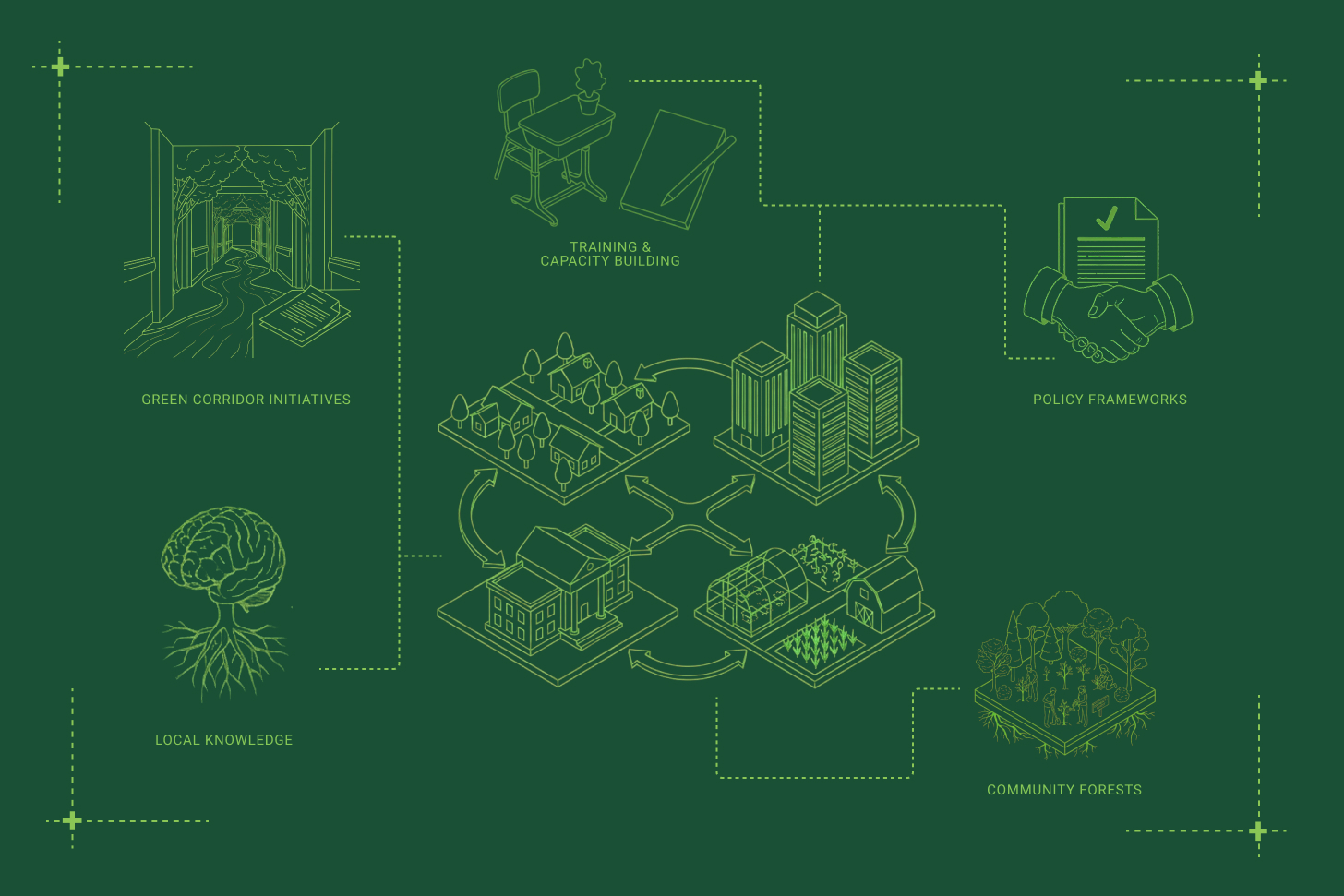
I want to suggest that the first core step to unlock our progress in “stuck” places is to build greater capacity in the partner ecosystem. That is a wonky idea, so let me break it down.
Governments can create the policy framework for public-private investment, including legal foundations for carbon market activities. They can help catalyze this system by putting in their own public money to seed restoration activities and by establishing a “flywheel” model where funding coming into a government-led project or partnership from private sources can be recycled to seed new activities and help draw in more private investment from others. Governments can also lead on applied science through forestry agencies and help with project assessment.
Communities can provide the boots-on-the-ground capacity, local knowledge, and long-term standing for these efforts to ensure that reforestation occurs and that the regenerated forests are sustained into the future. As the key economic beneficiaries, local communities can also play a leadership role in directing how local investment and community benefits funding can be applied most synergistically to advance reforestation and create community uplift that touches every community member.
Restoration-Focused Organizations like Terraformation can contribute scientific expertise in forestry and how to build the reforestation supply chain with innovation and rigor, can train + equip + mobilize local leaders through capacity building programs like Terraformation’s Seed to Forest Accelerator, and can directly partner with community-based organizations to implement reforestation at scale.
Companies can provide diverse catalysts, such as advanced market commitments for offtake of carbon credits, directing CSR dollars to reforestation projects lacking the scale or other parameters for carbon finance, directing corporate foundations to support ecosystem building activities, and finally using their public and political influence to speak on behalf of the entire endeavor.
When you look at the recent success in Brazil, what you see is a remarkable constellation of different entities acting like the sociopolitical equivalent of a food web. These actors include governments at all levels, companies from within and outside the country, NGOs from global leaders to community-based organizations, philanthropies, and local communities themselves.
When these actors are woven together in the right way, you can fuel landscape-level action with complementary inputs such as forestry science and innovation, training and other forms of capacity building, public policy and funding, market based finance and CSR, and catalytic philanthropy. Partner ecosystems like this also have the power to develop and project a shared narrative that builds support from the community to national level.
The Congo Basin is an example where this partner ecosystem has been incomplete, but is changing rapidly for the better.
This includes the laudable Kivu-Kinshasa Green Corridor initiative in the Democratic Republic of Congo, where 75 percent of Congo Basin deforestation is occurring. The new initiative, launched by His Excellency Mister Félix-Antoine Tshisekedi Tshilombo, President of the Democratic Republic of Congo, with support from partners such as the Virunga Foundation and World Economic Forum, is aiming to protect and restore 540,000 square kilometers, making it one of the largest conservation and restoration projects in the world.
I am proud that my organization, Terraformation, is also part of this ecosystem building in the Congo Basin through our partnership with the Government of Cameroon to launch a new reforestation initiative focused on Cameroon’s 1.7 million hectares of community forests. These lands in Cameroon are managed in concert between local forest councils and the national government, and represent a remarkable opportunity to reforest large swaths of Congo Basin rainforest while ensuring that this work is locally-led and that economic uplift is felt directly in local communities.
A Formula for Risk-Tolerant Finance

I want to suggest that there is one additional “meta hurdle” that we must address to get private investment into places like the Congo Basin—finding better ways to manage and embrace risk.
The simple reality today is that the Congo Basin and others like it are perceived as riskier places for private investment.
Governmental Risks that include political dynamics, regulatory gaps for carbon markets, and land tenure issues.
Contextual Country Risks that include pressure on protected and restored forests from alternative livelihoods and incursion for illegal timber harvest and mining.
Oversight Risks posed by the remote nature of the places we are restoring and difficulty of travel within these countries.
And even just the simple risk involved with working with partners and in places that might not have as long a track record as the countries that are the darlings of the moment.
These are serious barriers to private finance at a time when carbon markets are under pressure and buyers have many choices. That is why I want to suggest we need to develop a risk-tolerant funding strategy that can be deployed in these places where so much is at stake for our common global interests.
Such a finance approach for an “emerging” country could include the following elements:
- Seed: Combined pool of philanthropic investment to seed the enhancement of the partner ecosystem, from securing needed policy changes to capacity building with local implementers so that all pilot work meets certain technical standards and is positioned for scale.
- Pilot: Establish a pool of government funding leveraged by a pool of corporate social responsibility funding to launch pilot activities at the landscape scale. This would provide a show of confidence from the public and private sector and demonstrate the fundamental capacity of local actors to deliver.
- Prove: Secure contributions from multiple finance actors with strong country ties to establish a competitively allocated concessionary capital fund to scale the most promising landscapes and projects that emerge from the pilot phase in that country. In tandem, create a joint advanced market commitment from carbon market offtakers to send a signal to the projects coming from the pilot phase.
While this approach will not remove the inherently higher risks for these financiers and offtake buyers to engage in these emerging markets, sharing the risk among multiple actors can reduce the scale of exposure for any one of them while still assembling funding at scale. Further, the willingness of these private actors to provide this focused country-specific investment would help to secure government investment, philanthropic support, and buy-in from implementers and communities for the “seed” and “pilot” phases.
Reforesting the Future, Together
Are you feeling me? We really can go where needed most if we are willing to go in together, share the risks, and work together with carefully designed synergy. Much credit and thanks are due to the countries and their collaborators in places like Brazil that are showing the way.
Let’s come together as a global community to reforest the world with partnership approaches like I have described above. We need all the new thinking we can get, so please offer your own ideas in the comments to this article to say how you think we can make landscape-scale change happen in higher risk emerging places. I look forward to much more discussion on this in venues like Climate Week and COP, and you can count on Terraformation to create opportunities as part of our programming to think creatively on this together.